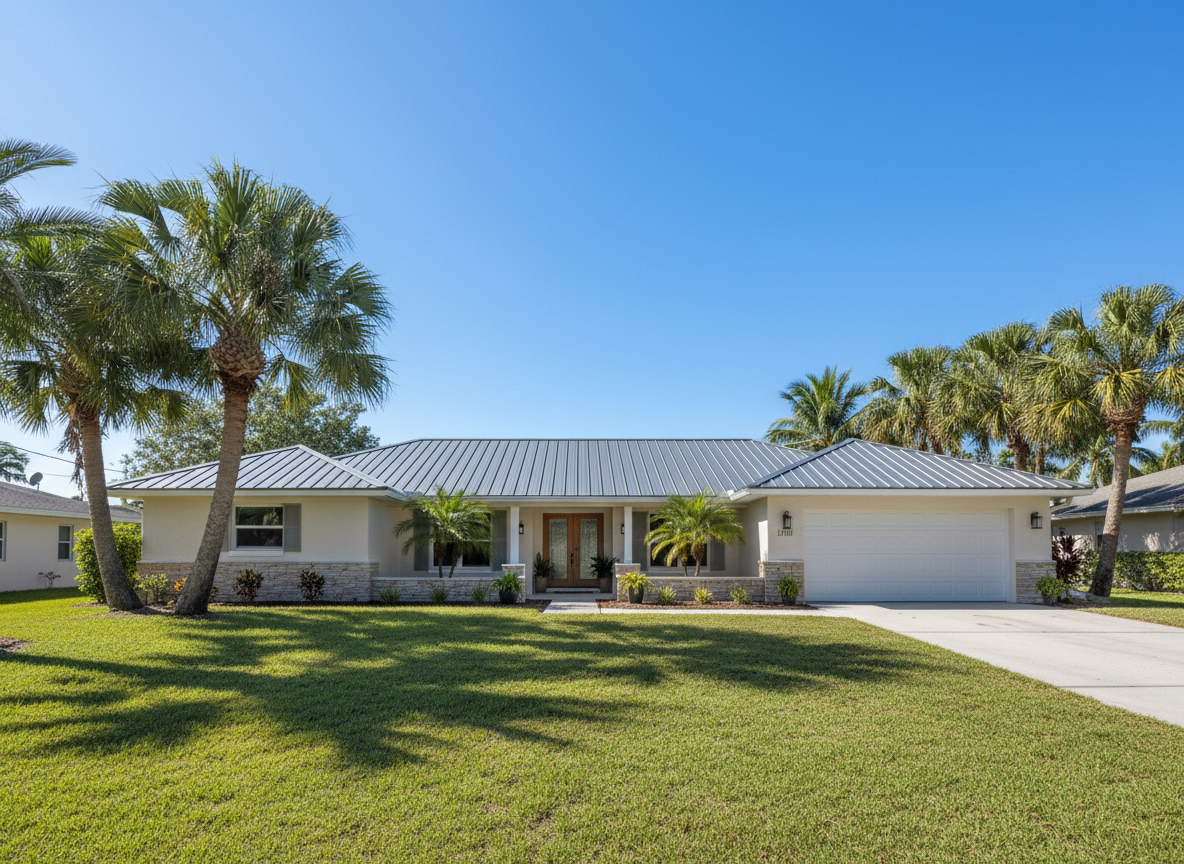
If you are building a home or adding a room in Clearwater, the roof is one of the first big choices the builder will ask you to make, and one of the hardest to change later. New roof installation in Clearwater means picking a roof system that handles summer storms, strong gusts and constant sun. It also has to meet the Florida Building Code for wind and water.
This page covers how to choose between shingle, metal, tile and flat roofing for a new roof, what the code asks of a roof installation, how the underlayment goes down, and the order the work follows from permit to final inspection.
Choosing a Roof Installation Contractor for a New Clearwater Roof
On a new build or an addition, the roofer is often chosen by the builder, but you can still ask the questions that decide how the roof performs. On a stand-alone project, such as a detached garage or a porch roof, you choose the roofer directly.
Ask any contractor quoting a new roof:
- Which roof covering and which exact product, and what wind classification is shown on its package?
- Which of the code's underlayment methods will be used, and why that one?
- How will the new roof be flashed where it meets walls, chimneys or the existing house?
- Who pulls the permit, and when are the inspections scheduled?
A contractor who answers with product names and code methods has thought about your roof. One who only talks about color has not.
The work follows a set order on almost every new roof. The permit is issued, the deck is built and inspected, the underlayment is applied, flashing and edge metal go on, then the roof covering, and finally the roof passes final inspection. Weather and inspection scheduling decide how long each stage takes, so ask the contractor to walk you through their schedule for your project.
Why New Roof Decisions in Clearwater Need to Be Made Early
Roof choices are locked in sooner than most owners expect. Tile is far heavier than shingle or metal, and the framing has to be designed for it. A low-slope addition limits which coverings can be used, because the code sets a minimum slope for each roof type.
Weather affects the schedule. The National Weather Service puts the local rainy season from about May 25 to October 10, with storms most afternoons, and a deck waiting for its roof needs dry days. Planning the roofing stage outside the wettest stretch, where the build allows it, reduces delays.
Insurance looks at the roof from day one. Citizens Property Insurance notes that documented wind mitigation features can qualify for premium discounts, so features chosen at installation can matter for years. Ask your agent which roof features your insurer considers before the roof is ordered.
Wind is the constant. During Hurricane Milton in October 2024, the station at Clearwater Beach recorded a gust of 78 knots, about 90 miles per hour. A new roof is the one chance to build in the wind resistance the home will rely on for decades.
What You Can Check on a New Roof
On a new roof, the checks that matter are ones you can make yourself, during the project or from the paperwork afterwards.
License. Florida licenses roofing contractors through the Department of Business and Professional Regulation. Check the license and its status at MyFloridaLicense.com before the contract is signed.
Permit and inspections. Florida's building permit law has no general exemption for roofing work. Keep the permit number and the final inspection record, because insurers, lenders and future buyers may ask for them.
Wind classification. The Florida Building Code requires asphalt shingles to be wind-tested and classified, with the class shown on the package. Ask to see a package label or the product sheet for what goes on your roof.
Underlayment method. The code allows a small number of underlayment methods. Ask which one is being used and, if you can, photograph the underlayment before the covering goes on.
Address. Roof Leak Repair Clearwater FL is at 4461 112th Terrace N, Clearwater, FL 33762.
When an Addition's New Roof Meets the Old One
Room additions, enclosed lanais and garage conversions are common in Clearwater, and almost every one ends with a new roof tied into an existing one. That joint is where many addition roofs leak, and the competing pages we reviewed hardly mention it.
The difficulty is that the two roofs are different ages and often different materials or slopes. The new roof has to meet current code, while the old roof next to it was built to an earlier one. Flashing has to bridge the two, and water from the larger roof often drains straight onto the new one.
Three decisions matter:
First, whether the new roof matches the existing covering or uses a different system suited to a lower slope. Second, how the valley or wall joint between the two roofs will be flashed and waterproofed. Third, whether any part of the existing roof has to be opened up to make the tie-in properly.
Ask for those three answers in writing before the addition's roof is framed. If the existing roof is near the end of its life, it may make sense to plan the two together.
The same applies to commercial roof installation on a small Clearwater building or an extension to one. Low-slope commercial roofs meet walls and older roof sections in the same way, and the tie-in detail decides whether the new section stays dry.
Roof Systems for a New Clearwater Roof
Asphalt Shingle Roofing
Asphalt shingle roofing is the most familiar roof on Clearwater homes: overlapping shingles nailed over underlayment, with a sealant strip that bonds each shingle to the one below. It costs less to install than tile or metal and suits most roof shapes and slopes above the code minimum. Its weak point here is wind and heat, which work on the sealant and the shingle edges over time.
For a shingle roof installation, the decision that matters most is the wind classification on the package, since the code requires shingles to be tested and classified for wind. Compare products by that class, not by color alone. When you talk to a shingle roofing company, ask for the product name, its wind class and the nailing pattern it will use, and keep that information.
Metal Roofing
Metal roofing uses steel or aluminum panels or shingles fastened over underlayment, either with exposed screws or with concealed clips on standing-seam systems. Metal sheds rain fast and resists wind well when fastened correctly, and the code requires metal panels to be wind-tested. Residential metal roofing usually costs more up front than shingle.
The main decision is the system: exposed-fastener panels cost less, while standing seam hides its fasteners and has fewer points for water to enter. Corrosion resistance matters too, and the code addresses it for metal roofing. For a metal roof installation, ask each metal roofing contractor or metal roofer which system they propose and how their metal roof installers will fasten it, and get the panel material and fastener type in writing.
Tile Roofing
Tile roofing uses concrete or clay tiles set over underlayment and fastened or adhered to the deck. Tile is heavy, which is why the framing has to be designed for it from the start, and it handles sun and heat well. The tiles mainly protect against weather, while the underlayment beneath does much of the waterproofing.
Tile roof installation costs more than shingle and takes longer, but it suits the look of many Clearwater homes. The key decisions are the tile profile, the underlayment, and how the tiles are attached for wind, which the code ties to engineered wind loads or an industry installation manual. When you speak to a tile roofing company, ask which attachment method they will use and which underlayment goes beneath the tile.
Flat Roof and EPDM Installation
Flat roof installation covers low-slope roofs on additions, porches, carports and some main roofs, using membranes such as EPDM rubber, TPO or modified bitumen. A low-slope roof cannot shed water quickly, so the membrane, its seams and the drainage do all the work. EPDM roof installation lays a single sheet of rubber membrane, which keeps seams to a minimum.
The decision is which membrane suits the slope, the use of the space and the drainage plan. Ponding water is the main enemy, so the roof needs enough slope and well-placed drains or scuppers. Before a flat roof is built, ask where the water will go in a heavy Clearwater downpour, and how the membrane will be sealed where it meets walls and the main roof.
Underlayment
Underlayment is the waterproof layer laid over the deck before the roof covering goes on. It is the roof's second line of defense: if wind lifts a shingle or cracks a tile, the underlayment is what keeps water out of the house. On tile roofs it does much of the waterproofing on its own.
The Florida Building Code allows a small number of underlayment methods, including fully covering the deck with a self-adhered membrane, taping the deck joints and covering them with underlayment, or applying two layers fastened with cap nails. The method chosen affects cost and how well the roof holds back wind-driven rain. Ask which method your roof will use, and ask to see the underlayment before it is covered.
Plan Your New Roof Installation in Clearwater
Call Roof Leak Repair Clearwater FL at [(727) 758-0462](tel:+17277580462). Tell us whether it is a new build, an addition or a stand-alone structure, and what roof style you are considering. Before you commit, ask for the product names, wind classification, underlayment method and permit details in writing.
If your current roof is the problem rather than a new one, see roof replacement or roof repair. For water coming in now, see the active leak guide, and to learn how leaks are traced, visit the [roof leak guide](/).